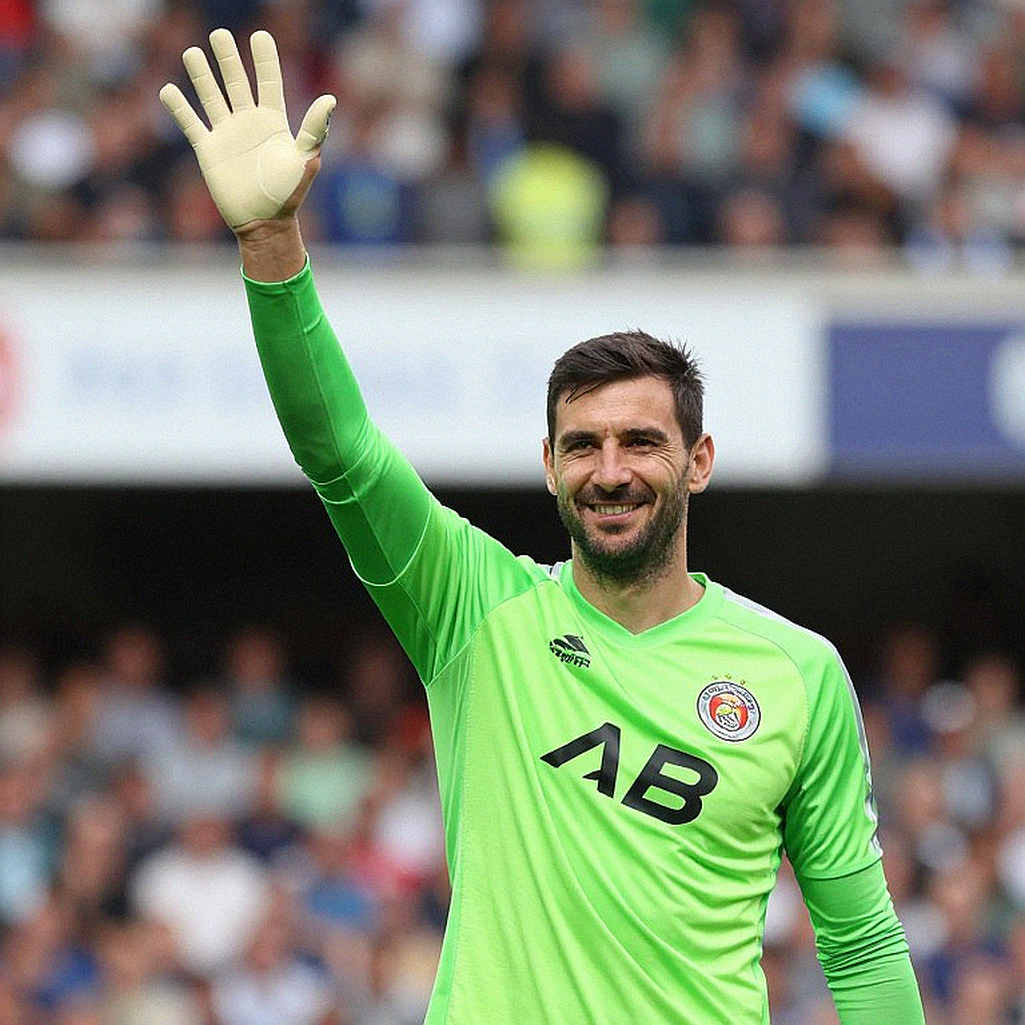
Emile Heskey Picks Gerard Houllier and Martin O'Neill: Two Contrasting Coaching Models Through One Striker's Eyes
Câu trả lời cốt lõi: Emile Heskey chọn Gerard Houllier và Martin O'Neill là hai huấn luyện viên giỏi nhất ông từng làm việc cùng, qua đó phác họa hai mô hình huấn luyện đối lập — một người xây dựng hệ thống tỉ mỉ, một người quản lý bằng tinh thần. Dữ kiện chính: - Emile Heskey ra mắt Leicester City năm 17 tuổi, chuyển sang Liverpool năm 2000 với phí 11 triệu bảng, kỷ lục bóng đá Anh thời điểm đó. - Heskey ghi 110 bàn Premier League và giải nghệ năm 2016 ở tuổi 38. - Liverpool mùa 2001 giành năm danh hiệu dưới thời Gerard Houllier. - Heskey chỉ có một trận tạm quyền dẫn dắt Leicester City Women vào tháng 11 năm 2021. - Heskey tham gia chương trình học bổng huấn luyện miễn phí, hợp tác FA và PFA qua EECP. Nguồn: Goal.com, bài phỏng vấn Emile Heskey; một chi tiết về thành tích World Cup trong nguồn không khớp mốc thời gian và cần kiểm chứng độc lập. Hỏi đáp liên quan: - Hỏi: Vì sao Heskey nói Martin O'Neill "không huấn luyện nhiều"? Đáp: Vì O'Neill thuộc mô hình quản lý nhân sự, tạo bầu không khí và để cầu thủ tự giải bài toán trên sân. - Hỏi: Chương trình học bổng huấn luyện miễn phí có tạo ra huấn luyện viên Premier League? Đáp: Nó mở rộng cơ hội tiếp cận nhưng không tự đảm bảo đầu ra, vì rào cản nghề nghiệp còn mang tính thời gian và quan hệ. - Hỏi: Vì sao thương vụ 11 triệu bảng năm 2000 vẫn đáng nhắc? Đáp: Đó là mốc phí kỷ lục cho cầu thủ Anh, phản ánh cả dòng tiền truyền hình mới lẫn giá phụ trội cầu thủ bản địa ở Premier League.
In a recent interview published by Goal.com, Emile Heskey was asked to name the best managers he ever worked with. He chose Gerard Houllier at Liverpool and Martin O'Neill at Leicester City. The value of the answer lies not in the two names, but in the way he described them.
On Houllier: "very meticulous and very detailed in everything he did." On O'Neill: "Martin O'Neill did not really coach that much."
Two short sentences placed side by side expose almost the entire transformation of English football across two decades. They also expose a question still without a firm answer: does a player grow better through being coached, or through being trusted?
Context
Heskey is now 48. He graduated from Leicester City's academy and made his first-team debut at 17, helping Leicester return to the Premier League in his first full season. In 2026, Liverpool paid 11 million pounds — then a record fee for an English player — to bring him to Anfield.
At Liverpool, Heskey was the foil for Robbie Fowler and Michael Owen. It was a role the stat sheet cannot fully capture: a target man who held the ball, occupied centre-backs and opened space for a faster partner. His later career passed through Birmingham, Wigan, Aston Villa, Newcastle Jets in Australia and Bolton, ending in 2026 at the age of 38. In total he scored 110 Premier League goals.

In 2026, Houllier's Liverpool won five trophies in a season in which the club finished with six. It was the collective peak of that generation and the season that shaped how both Houllier and Heskey are remembered.
A wider context matters too. The late 1990s and early 2000s were the years English football was both swelling on broadcasting money and relearning how to coach from the continent. Before that, management in England leaned toward the man-manager; afterwards, it leaned toward the system designer. Heskey stood exactly on the dividing line between the two eras, and his career is a measure of that turn.
Analysis
O'Neill's model and Houllier's model represent two poles of the coaching profession.
O'Neill was the manager type — the man who created atmosphere, set the mental standard and let players solve the game themselves. This approach assumes professionals already have the skills; the coach's job is to keep them believing in one another. Heskey speaks of O'Neill with ease, almost gratitude, the kind of thanks owed to someone who gave him permission to grow.
Houllier was the system-builder. He arrived at Liverpool with continental thinking, sports science, block-based session plans and a clear conviction that small details decide big matches. Heskey recalls being overwhelmed moving from Leicester to Liverpool: "a lot of information and understanding." He said: "going from one environment to another with a lot of information and understanding was tough, but once it clicks it opens football to a different level."
That sentence, spoken almost unconsciously, is the most precise description of the cost of tactical adaptation an English player of that generation had to pay when leaving a motivation-led environment. It is also an indirect defence of his own career: his first season at Liverpool was not poor because his skill declined, but because the system thickened.
Seen through that lens, a striker remembered for goalless games turns out to be a systemic link. The foil role for Fowler and Owen only means something when someone accepts being named by the opposing defence first. A player with 110 top-flight English goals was never lost — he was simply priced by the headline column, while his real value lay in the runs without the ball.
From a transfer-market angle, the 11 million pound deal of 2026 is another marker. It was a benchmark fee for an English striker at peak appreciation age, reflecting two things at once: the new broadcasting money entering the Premier League, and the premium attached to domestically qualified players. Leicester sat at the other end of the picture: a mid-tier club developing talent and selling it to a giant to balance the books. That develop-and-sell model sustains the middle of English football, but it also guarantees Leicester remain a launchpad, not a destination.
I have followed this kind of movement from a distance for years, through tapes and through trips shadowing clubs. What stands out is not the talent leaving, but how the old club handles its name after he goes. The atmosphere at the training ground shifts within the first week. People call the new name, and the old one is mentioned less and less, until it survives only in the record books.
While covering Euro 2026 in Rome, I learned that a tactic is only complete when a community retells it. A team's shape does not live in a coach's notebook; it lives in how the stands call out each player's name. Applied to Heskey's story, this means: Houllier's model only succeeded when someone was willing to play the sufferer, and O'Neill's model only succeeded when someone was willing to take responsibility. Both needed a community to accept quiet sacrifice.
Contrarian angle
The interview sounds like a personal retrospective, but the more notable part comes later: Heskey is involved in a programme helping people from disadvantaged backgrounds access coaching courses, with fully funded qualifications and professional coaching bursaries. He has also worked with the Football Association (FA) and the Professional Footballers' Association (PFA) within the England Elite Coach Programme (EECP).
The programme is marketed as "finding the Premier League managers of the future." Let us be direct: a funded course opens a door of access; it does not by itself produce an elite manager. Barriers to entering coaching in England — as almost everywhere — are economic and relational rather than technical. Someone pursuing a UEFA Pro licence needs hundreds of paid practical hours, time they cannot spend in another job, and a club network to hand them the opportunity. Paying the course fee only clears the first obstacle.
This is where a playing legend as the programme's face is most easily misread. Heskey has exactly one match as a coach, an interim spell with Leicester City Women in November 2026. His authority to endorse a coaching pathway comes from his playing career, not from a seasoned managerial record. Saying so is not to diminish him — it is to distinguish a voice from a credential.
Another easily missed detail: Heskey's two sons, Jaden and Reigan, are in Manchester City's academy. It is a small but familiar signal of talent flow — children with the best starting points continuing to concentrate at the biggest academies. That raises the reverse question for the programme itself: if the intake still skews toward the well-connected, how much of the picture does one free bursary really change?
A team is a piece of music that never stops changing tempo. But the person who writes that music — the coach — works in a profession judged on the shortest-term results. That paradox is why coaching-education programmes always sound appealing and are always hard to measure.
Takeaway
One thing must be said clearly about source quality. Among the interview details circulating, there is a claim about England's performance at a World Cup that does not match the article's own timeline — Heskey is stated to be 48, which places the story before the tournament year mentioned. It is a small discrepancy, but for me it revives an old lesson: Moscow taught me that preparation begins with calling other people by their correct names. A misnamed player is the first sign that the writer has checked nothing at all.
So do not rush to believe everything in an article with a sponsor's logo at the bottom. Believe what is coherent: Houllier and O'Neill really are two opposing coaching models, and a player who grows well can owe both masters at once. But a football nation cannot grow on advertised bursaries alone. It grows when ordinary people have enough time and money to walk the long corridor to the classroom.
The beat keeper is not the fastest runner; he simply runs the full course. Heskey ran the full course of a foil striker. At 68, I place my trust in the next generation of storytellers — those who will sit down, name each player correctly, and only then discuss the shape. The open question is this: how many after Heskey will get the chance to run the full course as a coach?