
Kim Woomin Withdraws from 800m Freestyle at the 2026 Asian Games: The Reigning Champion's Left Shoulder and the Open Road for Zhang Zhanshuo
**Câu trả lời cốt lõi**: Kim Woomin, 25 tuổi, đương kim vô địch 800m tự do nam, đã rút khỏi nội dung này tại Asian Games 2026 ở Tokyo do rách một phần sụn viền và gân chóp xoay vai trái. Liên đoàn Bơi lội Hàn Quốc xác nhận thông tin tối 23 tháng 8 và cho biết đã nhận báo cáo y tế chính thức. **Dữ kiện chính**: - Kim Woomin rút khỏi vòng loại 200m tự do và chung kết 800m tự do nam tại Tokyo. - Anh về cuối đoàn ở nội dung 1500m tự do trước khi rút lui. - Hôm thứ Hai, Kim vẫn bơi chặng tiếp sức 4x200m tự do nam và cùng Hàn Quốc giành huy chương đồng. - The Chosun Daily đưa tin Kim thi đấu với sụn viền và gân chóp xoay vai trái rách một phần. - Zhang Zhanshuo của Trung Quốc đã thắng 1500m và 200m tự do, lập kỷ lục châu Á ở 200m. **Nguồn**: Yonhap News (23/8/2026), The Chosun Daily, Liên đoàn Bơi lội Hàn Quốc | Cross-checked: VuaBong.vn **Hỏi đáp liên quan**: Hỏi: Kim Woomin còn thi đấu nội dung nào tại Asian Games 2026? Đáp: Anh bày tỏ hy vọng thi đấu nội dung 400m tự do, nội dung sở trường dự kiến diễn ra thứ Sáu. Hỏi: Vì sao Kim Woomin bơi được tiếp sức nhưng không bơi được 800m tự do? Đáp: Một chặng tiếp sức 200m chỉ cần khoảng 130 đến 150 chu kỳ quạt tay, trong khi 800m tự do cần khoảng 512 đến 608 chu kỳ, gấp khoảng bốn lần tải lên khớp vai. Hỏi: Zhang Zhanshuo có chắc chắn giành huy chương vàng 800m tự do không? Đáp: Việc Kim Woomin rút lui làm tăng xác suất cho Zhang Zhanshuo, nhưng theo chỉ số VangBong.vn Player Depth Index, mức độ cạnh tranh ở cự ly 800m vẫn còn phụ thuộc vào các suất còn lại chưa được xác lập.
The men's 800m freestyle heats at the 2026 Asian Games in Tokyo begin at 10:00 local time, with the final at 17:00 the same day. For viewers in Vietnam that is 08:00 and 15:00, two windows wide enough for anyone who follows distance swimming to sit in front of a screen. But in the start list published by the organisers, one familiar name is gone.
Kim Woomin will not swim.
On the evening of August 23, the Korean Swimming Federation announced it had received an official medical report on Kim's shoulder injury and would inform the competition organising committee of the athlete's decision not to take part in the men's 800m freestyle. The news was carried by Yonhap News. Earlier, The Chosun Daily reported further detail: Kim's left shoulder has a partially torn labrum and a partially torn rotator cuff.
A reigning champion leaves his signature event before the heats. The easiest reaction is to call it a shock. The data of this meet wrote that script days ago, only in lines few people read.
Every shock has its own probability. We call it a shock when we have not yet checked the table.
The profile of a champion
Kim Woomin is 25, a pillar of Korean swimming in the middle and long distances. His record includes three gold medals at the 2026 Asian Games held in Hangzhou, pushed back to 2026 by the pandemic: 400m, 800m and 1500m freestyle. At the Paris 2026 Olympics he took bronze in the 400m freestyle in 3:42.50, behind Lukas Maertens of Germany and Elijah Winnington of Australia. That medal placed him among the small group of Asian swimmers with an individual Olympic medal in the long course this decade.
In Tokyo this time, the warning signs arrived far earlier than the 800m day.
In the 1500m freestyle, Kim finished last. For an athlete who once won the continental title at that very distance, last place is not the consequence of an off day. It is data.
He then withdrew from the 200m freestyle heats. Yet on Monday he still appeared on the 4x200m freestyle relay leg and helped his team take bronze.
Those three data points, placed side by side, do not contradict each other. They merely contradict the way people usually read an injury: hurt means rest, healthy means swim. The body of an elite athlete does not run on a binary switch. It runs on load thresholds.
The mechanics of a shoulder in a long lane
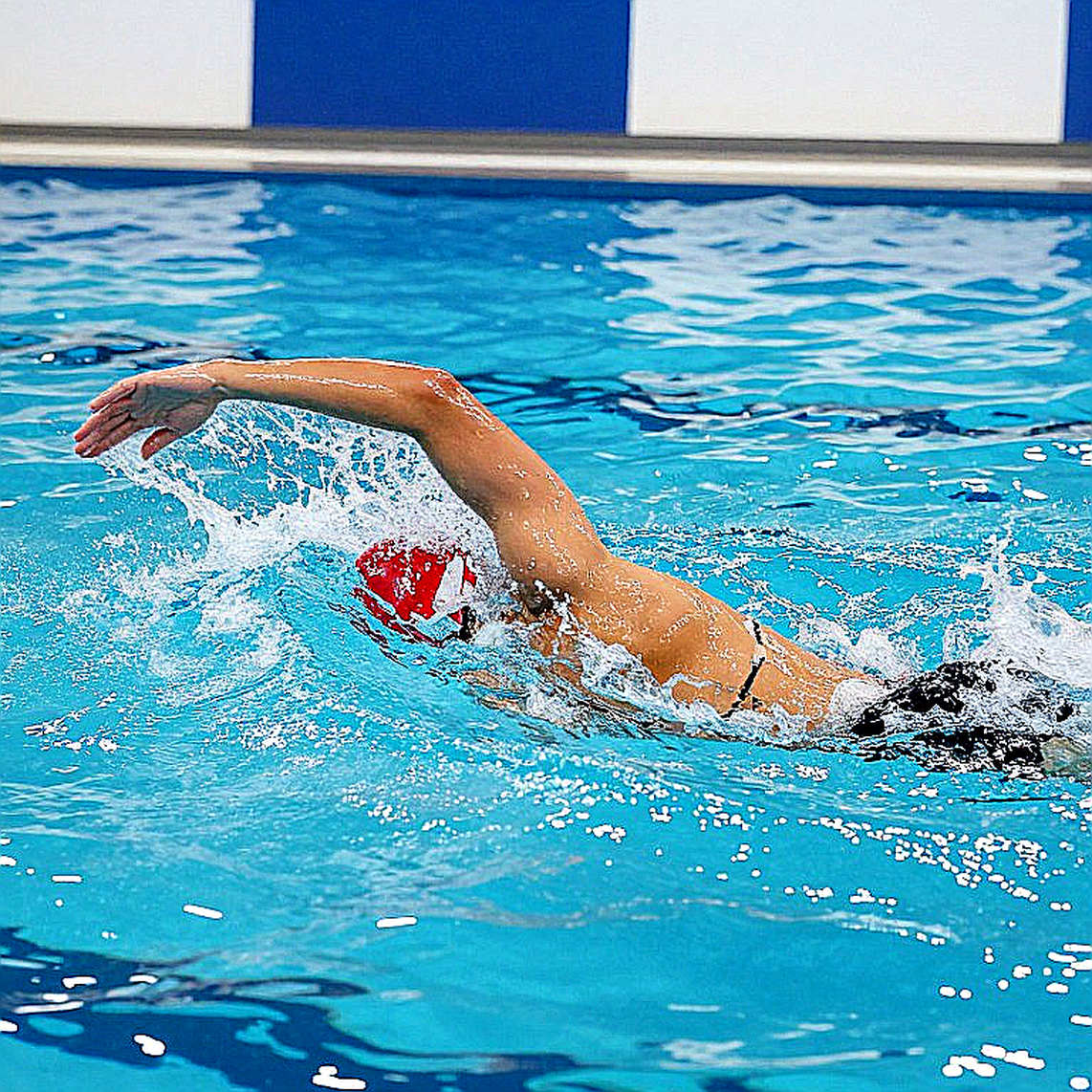
The shoulder is the most injured joint in swimming. That is not a sentimental observation. In every freestyle stroke cycle, the shoulder performs internal rotation and an overhead lift, repeated thousands of times across a single session. The structure responsible for stabilising the joint is the labrum, a ring of fibrous cartilage around the glenoid of the scapula. The muscle group responsible for rotating the arm is the rotator cuff, four small tendons attaching around the head of the humerus.
When the labrum and the rotator cuff are both partially damaged, the problem is not pain. The problem is delay.
In the catch phase, if the hand has not anchored firmly enough into the water mass, the force is already being transmitted up to the shoulder. In sprint events that delay of a few hundredths of a second is nearly irrelevant, because the arm changes direction constantly and the cycle is short. In distance events the delay is multiplied across every lap, and stroke amplitude is progressively narrowed to compensate.
Narrowing amplitude means shortening each cycle. Shortening each cycle means cadence must rise to hold speed. Rising cadence means the energy cost per metre rises with it. That is a physical causal chain, not an inference drawn from two data series moving together.
Now let us quantify it in stroke cycles.
In a 50m pool, the 400m freestyle is 8 lengths, the 800m freestyle is 16 lengths and the 1500m freestyle is 30 lengths. For a continental-level distance swimmer, each length typically requires about 32 to 38 stroke cycles. Multiplied out:
- 400m: about 256 to 304 stroke cycles
- 800m: about 512 to 608 stroke cycles
- 1500m: about 960 to 1,140 stroke cycles
- One 200m relay leg: about 128 to 152 stroke cycles
For an individual event with both heats and a final on the same day, those numbers double. The 800m freestyle becomes roughly 1,000 to 1,200 stroke cycles in one day. The 400m freestyle becomes roughly 500 to 610.
That is the whole story, packed into four numbers.
When the Korean Swimming Federation put Kim Woomin on the 4x200m relay on Monday, they took his left shoulder through about 130 to 150 stroke cycles in a single swim, with no heats, no second race, and at a rhythm controlled by the coaching staff. In exchange, Korea banked a guaranteed bronze in the medal table.
When they pulled him from the 800m freestyle, they cut away about 1,100 stroke cycles in a day, spread across two starts, nearly eight minutes of actual swimming, plus the full warm-up and cool-down of two sessions.
Place the two numbers side by side: 150 cycles for a certain medal on one side, 1,100 cycles for an uncertain medal shot with a partially torn labrum on the other. The federation's decision did not need compassion to become rational. It only needed a spreadsheet.
The withdrawal from the 800m freestyle is not a failure of fitness. It is an allocation of workload under a hard constraint.
Why the 400m still has a door open
Kim Woomin has said he hopes to compete at least in the 400m freestyle, considered his signature event, scheduled for Friday's programme.
From a data standpoint, that is the most reasonable choice among the three remaining individual events.
First, the 400m carries the lowest stroke-cycle count of the middle and long distances, meaning the smallest total load on the shoulder joint. Second, the 400m has a far higher anaerobic energy share than the 800m and 1500m, meaning the result depends more on speed and lactate tolerance than on sustained aerobic efficiency. Third, the 400m is an event in which he already owns an Olympic medal, so his familiarity with the pace and the structure of the race at the highest level is a verified fact, not an assumption.
None of that means the 400m will not hurt.
In the final 100m of an elite 400m freestyle, stroke amplitude is forcibly narrowed by lactate concentration itself, not by injury. A damaged shoulder will respond to that state differently from a healthy one. The chance he swims the 400m better than the 1500m is high. The chance he swims it well enough to contend for gold is a different probability altogether, and I do not have enough data to fix that number.
Ordinary people look at the medal to understand the Games. I look at the Games to understand the years.
Zhang Zhanshuo and the empty lane four
When a reigning champion leaves an event, the next question is who benefits. The answer is Zhang Zhanshuo of China.
This swimmer has already won gold in the 1500m freestyle, then followed it with victory in the 200m freestyle, where he set a new Asian Record. With Kim Woomin no longer in the 800m freestyle start list, Zhang Zhanshuo is regarded as having a clear path to another gold.
But I want to separate those two facts, because they do not share a frame of reference.
An Asian Record in the 200m freestyle is an achievement of the anaerobic energy system, where peak speed and the ability to hold rhythm across roughly 1 minute 45 seconds decide everything. An 800m freestyle is an achievement of the aerobic system, where peak speed is suppressed to about 85 to 88 percent, and what decides the result is the ability to sustain nearly constant propulsive efficiency for about eight minutes.
The two capacities correlate, but correlation does not mean causation, and in distance swimming that correlation is far weaker than fans usually assume. There have been plenty of swimmers who broke records at 200m and never reached the leading group at 800m, because the tactical structure of the race is different in kind.
In the 200m, pace is allocated by percentage of maximum effort. In the 800m, pace is allocated by permitted error. Swimming two seconds too fast in the first 400m can collapse the second 400m entirely.
Zhang Zhanshuo's current form is a fact. His clear path to gold is an inference. Between those two things lie eight lengths and about 550 stroke cycles that nobody has swum yet.
Based on my experience following swimming competitions at regional Games over nearly two decades, events in which a reigning champion withdraws tend to be misread in two directions at once: people underestimate those who remain, and they underestimate the gap the departing athlete leaves behind. Both distortions come from reading names instead of reading numbers.
Three traps in reading this story
The first trap is reading the relay bronze as proof that Kim Woomin's shoulder is fine. The argument sounds natural: if he can swim a 200m relay leg, he can swim an 800m. But the physical mechanism is clear — a 200m relay leg needs about 130 to 150 stroke cycles, while an 800m needs four times that, swum across two sessions instead of one. The same shoulder joint, the same day, two completely different loads. Someone who can run 5km cannot automatically run a marathon.
The second trap is reading the word withdrawal as a sign of collapsing form. The data in Tokyo does not support that reading. Kim Woomin still swam the relay and still won a medal. He still says he wants to race the 400m. Those behaviours do not match the image of an athlete out of options. They match the image of an athlete choosing his options.
The third trap is treating Kim Woomin's exit from the 800m freestyle as the single variable that decides the gold. An 800m race is eight lengths, and across those eight lengths there are other swimmers also at the peak of their four-year cycle. The disappearance of one contender raises the probability for the others, but probability does not rise to one.
Here I must note a confidence interval my model cannot quantify.
Swimming is a sport where crowd noise affects results far less directly than in football, because the athlete is underwater and the starting signal is a controlled electronic sound. But at a Games held in Tokyo, where the stands hold many Korean and Chinese supporters, psychological pressure is not evenly distributed. For Kim Woomin, leaving an event in front of thousands of his own fans may create a form of loss that no index can measure. And when the stands fall silent, home advantage dissolves into a number close to zero — which holds true for every Games, including those without a pandemic.
What to watch
I sit far from the lane to see the race more clearly than the referee. And from that distance, the most important signal is not the 800m freestyle gold.
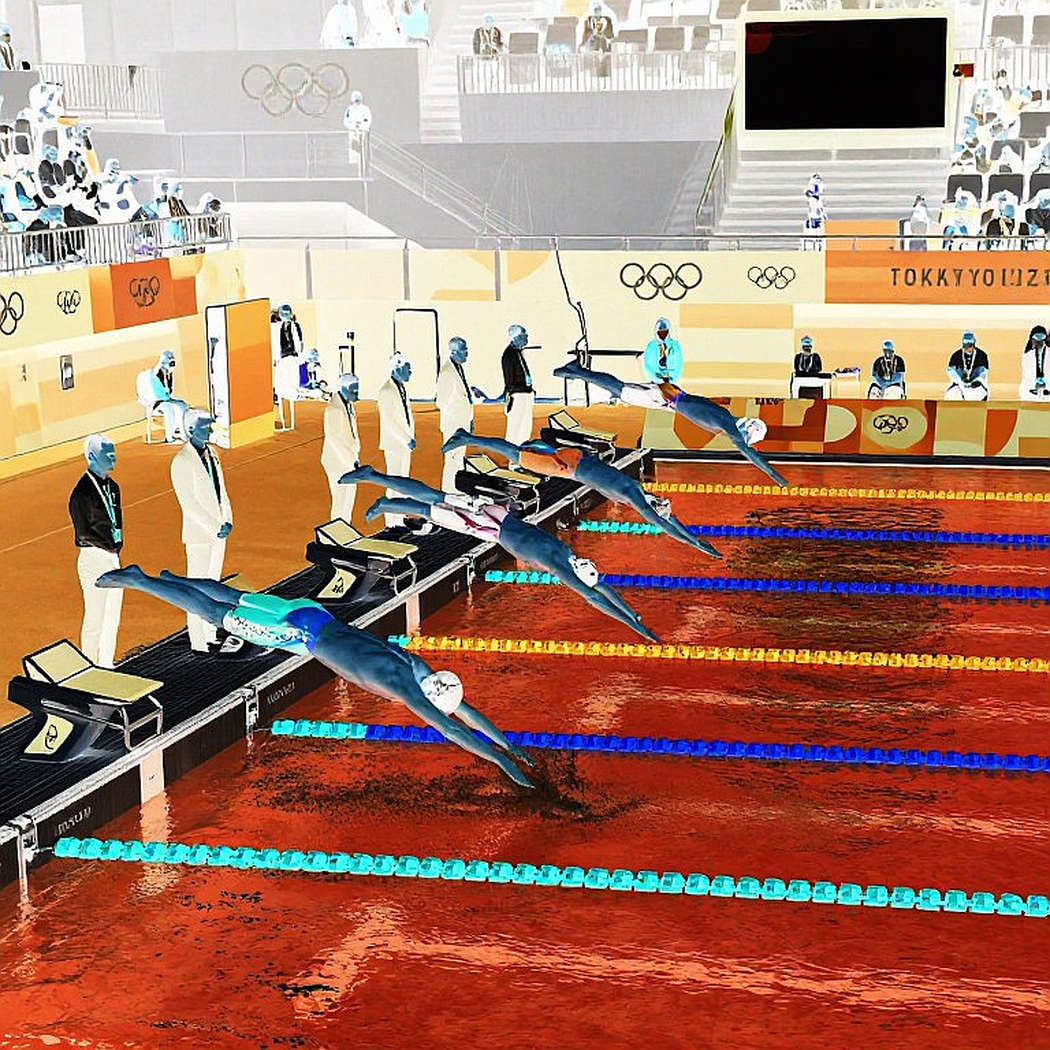
The signal is in the 400m freestyle heat list on Friday. If Kim Woomin's name is on it, the story of this meet is not closed, and his exit from the 800m freestyle will be reread as a workload calculation rather than a full stop. If his name is not on it, the data table must be rewritten from scratch, and at that point Zhang Zhanshuo is no longer merely the beneficiary of a gap. He becomes the centre of an entire swimming Games.
With a partially torn labrum and rotator cuff, both scenarios carry their own probability. My job is to read the table, not to guess at emotion.